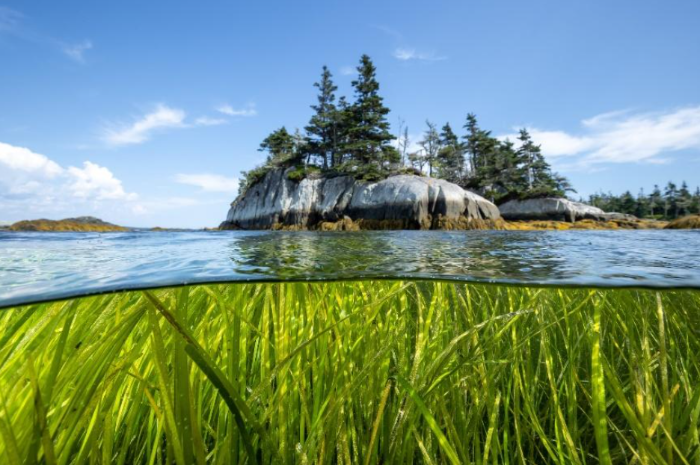
Climate adaptation can take many forms. Along the shoreline of Nova Scotia, you can find it in the delicate green blades of eelgrass, rippling under the surface of the water.
Eelgrass is an essential part of Nova Scotia’s coastal ecosystem; eelgrass meadows provide habitat, protect the shoreline, and absorb carbon.
Eelgrass is under threat, from invasive species, climate change, and coastal development. Some scientists estimate that across North America, a football field of eelgrass meadows are lost every hour.

The Community Eelgrass Restoration Initiative is bringing together researchers, citizen scientists and local communities to document what’s left — and restore what’s disappeared.
“We’re trying to better understand the role of eelgrass in Nova Scotia but also raise its profile and share these many benefits it has with the public — eelgrass is a wonderful plant and not very many people know that we have extensive grass meadows around Nova Scotia,” said Kristina Boerder, lead scientist with the Community Eelgrass Restoration Initiative and researcher at Dalhousie University’s Future of Marine Ecosystems Research Lab.
The idea for the Community Eelgrass Restoration Initiative, or CERI, was sparked in 2020, when Boerder and other scientists discovered healthy eelgrass beds in some parts of the province. “That spiked our interest in how the eelgrass looks around the province…and then finding out that we don’t know much about it.”
(Kristina Boerder with CERI)
Project aims to survey eelgrass meadows
In 2023, CERI launched with funding through Fisheries and Oceans Canada’s Aquatic Ecosystem Restoration Fund.
Boerder said eelgrass is an important species as it provides crucial habitat for a range of species, from lobster to herring. “A lot of species that we cherish in the Maritimes [call] it their home at some stages throughout their lives.”
Eelgrass meadows buffer wave action, protecting the shoreline against storms. Boerder said meadows can reduce wave energy by up to 40 percent.
Eelgrass can also mitigate climate change. “It’s one of these unsung heroes to help us mitigate climate change.” said Boerder. As it grows, it deposits carbon in the sediment beneath the meadow, where it can stay locked away for centuries to millennia. “And it does that about 30 times more efficiently than forest on land,” said Boerder. “That really is something that we call a true carbon sink.”
To support this vital ecosystem, CERI has been searching for meadows around the province and surveying their health and extent over time. To expand their reach, the Initiative draws on a team of citizen scientist volunteers using iNaturalist to track eelgrass.

Eelgrass affected by climate change, development
What those surveys show isn’t always pretty. As climate change increases water temperatures, eelgrass is suffering. “This is a cold water species, so it doesn’t do too well with waters that are too warm over too long a time,” said Boerder.
Variations to the seasonal patterns of temperature and salinity that eelgrass needs to complete their life cycle, as well as more severe storms and invasive species such as green crab, are undermining the health of eelgrass meadows.
Some approaches to protecting coastlines, like using hard armour stones or seawalls, can change habitats and make it hard for eelgrass to thrive. “That really impacts eelgrass at many sites that we’re seeing where…we’ve seen the eelgrass recede from the coast by up to 20, 30 meters. That was quite eye opening,” said Boerder.
Restoring Eelgrass in Nova Scotia

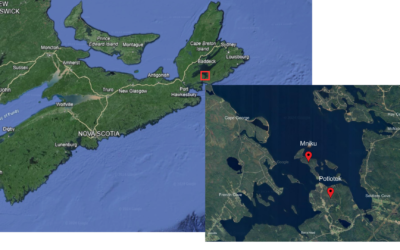
Working with communities, CERI is attempting to restore some meadows that have disappeared. The Initiative has a particular focus on working with Mi’kmaw communities and has collaborated with Pictou Landing First Nation to restore eelgrass meadows around an important island for the community. The Initiative is also in conversation with Paqtnkek, whose traditional eel fishing grounds have experienced declining eelgrass, to work on a restoration project this summer.
(Community Volunteer)
CERI is also studying genetic strains from different parts of the province to identify populations of eelgrass that are more likely to withstand the warmer conditions anticipated in the future. This is being combined with analysis to determine which areas of the province will be most suitable for eelgrass going forward. It doesn’t make much sense to restore an area that will become unsuitable over the next 10 years or 20 years,” said Boerder.
To grasp the effectiveness of eelgrass as a carbon sink in Nova Scotia, CERI is taking sediment cores from eelgrass meadows to assess how much carbon they’re sequestering, and how much would be released if they were destroyed.
Boerder said one unanticipated outcome of the project thus far has been the connections they’ve forged with community members. At a time when news about climate change can be dire, participants in the project report a sense of well-being from being involved in work to restore ecosystems. “That was something we didn’t really account for in the beginning of the project, but that has become a big part of what we’re doing.”
And to see areas that had been barren mud once again bursting with life after a replanting is rewarding, Boerder said. “This helps to make changes on a small scale, but regardless it means a lot because the species are coming back where the grass grows again, and that has been wonderful.”
Additional Resources:
- Nova Scotia Government Coastal Adaptation Resources: http://novascotia.ca/coastal-climate-change
- CLIMAtlantic: https://climatlantic.ca/
- Coastal Adaptation Toolkit: https://climatlantic.ca/coastal-adaptation/
- Community Eelgrass Restoration Initiative: https://eelgrass.ca/
- Eelgrass maps in Canada: https://www.canada.ca/en/environment-climate-change/services/environmental-indicators/eelgrass-canada.html
Funding support provided by: